
Coffee Oysters Champagne Is Becoming “Hotel à Toi” — A Secretive New King West Concept
Running a restaurant in Toronto has never been an easy business, and even long-standing, well-loved spots aren’t immune to thin margins and rising costs. Now, one of King West’s more distinctive cocktail bars is being reinvented from the ground up, marking a genuine changing of the guard for the neighbourhood.
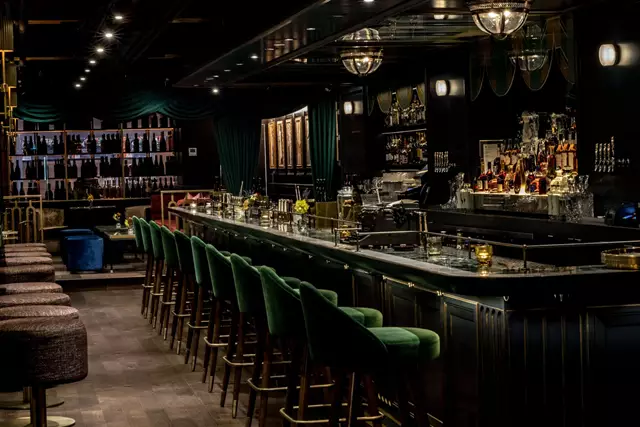
Coffee Oysters Champagne (COC), the blush-pink oyster bar that’s anchored a small but well-known storefront on King Street West since 2018, is closing entirely. Behind it, though, sits the real draw: à toi, the elaborate hidden speakeasy modelled after a 1920s Parisian hotel lounge, accessible only through a concealed door that guests would find while touring the restaurant’s champagne cellar. According to Sanjay Singhal, founder of Forthspace Hospitality Group, that speakeasy is the foundation the whole new concept is being built around.
“It is and it isn’t a rebrand,” Singhal says. “COC is going away; nothing of it is going to remain.” In its place: hotel à toi, a much larger and more theatrical version of the original secret bar, unifying what used to be two separately branded spaces — the restaurant and the speakeasy — into a single, cohesive hotel-inspired concept.

The decision came out of a genuine reckoning with declining traffic. Singhal says he and his team spent a long stretch trying to diagnose why business had slowed — whether it was the economy, the industry at large, or the concept itself simply aging out. Their conclusion: the novelty of COC’s hidden door had worn off. People used to love stumbling onto the secret entrance; that thrill had faded. Rather than shrink the ambition of the space, as he’d initially considered with a simpler bakery or ice cream shop pivot, Singhal decided to go the opposite direction and lean fully into the theatrics that had always defined à toi.
It’s a familiar move for Singhal, whose past projects have leaned heavily on immersive storytelling — including the now-closed Runway 06, an airport-themed restaurant with five distinct experiences under one roof, and before that, the South American-themed brunch spot Marked.
Hotel à toi is built around an elaborate fictional backstory: a boutique hotel supposedly built in Toronto in 1920 by a Parisian husband in honour of his Canadian wife, who studied in Paris and later returned home with him. The building’s proprietress, a haughty widow named Isabel, still supposedly haunts the place after her husband died before finishing construction, under circumstances the lore describes only as a “mysterious misunderstanding.” Visitors who ask the right question at the front — inquiring about the hotel’s gift shop — get led further into the space by staff playing characters, eventually meeting Isabel herself. Singhal says the details of the lore are woven subtly throughout the space, from custom menus to books on shelves that hint at the backstory without spelling it out.
The physical space is being redesigned to match: a reception desk to reinforce the hotel illusion, more front-of-house seating than COC ever had, and a custom-built Eiffel Tower on the patio, sourced from Europe. Singhal wants the front room to function as a destination on its own, rather than the transitional afterthought it was before, when limited seating out front meant the vibe skewed heavily toward getting people through to the hidden speakeasy as quickly as possible.
The stakes are real. Singhal is candid that both COC and à toi — spots that have hosted the likes of Auston Matthews, Mitch Marner and Drake — have seen real declines in traffic over the past couple of years, part of a broader pattern he says is hitting restaurants across the city as consumers spend less even when foot traffic holds steady. He’s framing the overhaul as a calculated risk rather than a safe bet, timed deliberately to launch just weeks ahead of the Toronto International Film Festival.